

How To Draw A Stick Dog
Pup portraiture: How to describe dogs.
Whether you're painting a realistic dog or sketching a cute cartoon puppy, selection up some new tricks for capturing canine personality and emotion.
All-time friends deserve shut attending.
Dogs are ideal companions. They're frequently more than attuned to our thoughts and feelings than nosotros are, and they tell us a lot through their expressions and torso language. To depict a dog well, representing accurate anatomy and capturing their distinct personality, you have to examine them closely.
Study reference photos.
Before you lot follow whatsoever footstep-by-step drawing tutorials, determine the breed or combination of breeds you lot desire to depict. A dachshund has quite dissimilar dimensions from a husky or gilt retriever, and all of those have completely different faces from a pug or Boston terrier. Study examples of the brood in photos, noting the distinctive characteristics. Primal differences tend to bear witness upward in the following areas:
- Trunk type: Large or small, broad- or narrow-chested, long- or curt-legged
- Nose length and shape: Pronounced snout or smushy face, broad cage or narrow
- Ears: Upright or folded, large or minor
- Fur length: Short or long; directly, wavy, or curly
- Fur color: Everything from solids to stripes to spots or combinations of all three
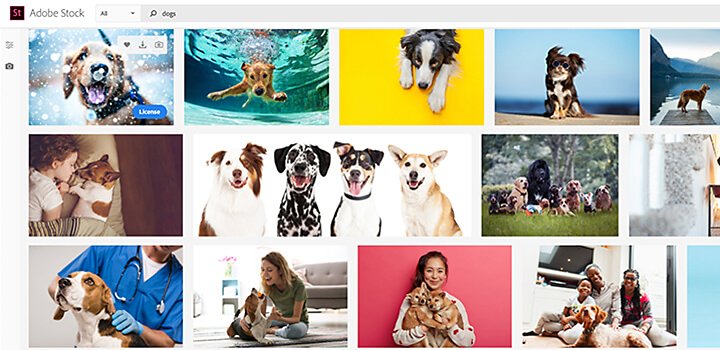
For useful reference photos of many types of dogs in every possible position, explore dog photos on Adobe Stock. If you're drawing a portrait of a specific canis familiaris, try to find equally many reference photos as you can to get a sense of the domestic dog'southward personality.
If you depict or paint digitally, you can pull reference right onto your sheet and even practice by tracing one or 2 digital domestic dog photos. Check out this step-by-footstep Adobe Photoshop Sketch tutorial to get started.
Understand dogs' bodies.
Your cartoon can do good from learning about canine muscular and skeletal structure. "One of the most helpful things when you're drawing any kind of creature is to realize how their anatomy conforms with our ain," says artist Jonathan Example. A canis familiaris's skeleton is fairly similar to that of a human, with a spine connecting the caput and neck to a prominent rib cage and pelvis, merely the hips and neck are angled, and the proportions of the basic are different.
Dogs' legs can be specially difficult to capture. "What we call up of every bit the dog's elbow is actually similar their ankle, and their back legs take a very unlike structure from the front," artist Megan Levens explains. "They're upwardly on their toes similar most animals." Becoming familiar with the skeletal structure gives you a literal and figurative foundation to build upon. "In one case you lot take an idea of how to rest that back pes and sympathise where their thigh muscle sits in relation to their knee and their ankle, you go a ameliorate understanding of how to proportion them," says artist Lucas Elliott.
Begin your drawing with basic shapes.
Utilise simple shapes to create a rough outline of the dog'due south body. Draw lightly — or, if y'all're drawing digitally with Adobe Fresco, use a layer you'll hide later. "For a dog with a longer snout, I'll draw a brawl or a rounded cube for the principal part of the dog's head, the attic, and and so I'll add a cylinder, rectangle, or some sort of block for the rest of the snout," says Levens. "For shorter-faced dogs, it ends upward being 2 cubes kind of blocked together, or fifty-fifty one cube. And and so a cylinder for the chest and a smaller rounded cube for the hip area."
For the legs, remember that the upper leg bones (femur and humerus) announced shorter than the lower leg bones. Bank check your sketch against reference photos and make adjustments until you lot're satisfied with the proportions.
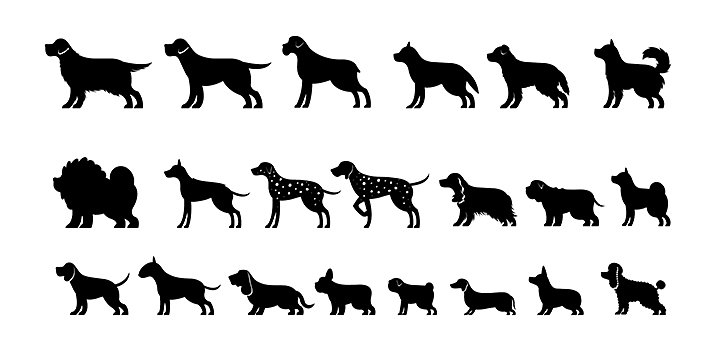
Refine the silhouette.
Start turning those bones shapes into a canis familiaris's body past connecting and refining the outline. Again, refer to your photos to judge whether the back is a directly line or slightly curved. Conform as necessary, peculiarly when checking those tricky hind legs. If the dog is fluffy, the outline may exist softer, but don't forget near the muscle under the fur. "You lot still have to know where the class is and how that dictates where the fur is going to grow," Levens says. "That's going to show you where the musculature is."
Fill in the blanks.
Begin erasing your guidelines or hiding the outline layer if you're cartoon digitally. Then add more than detail to the body contours, shading in the shadows that suggest muscles and fur variations. Note how the light hits the ears and nose, and don't forget the tail. For valuable tips on how to add color and texture to an adorable drawing dog — and which brushes to use — watch this Adobe Alive tutorial with illustrator and designer Natalie Murrow.

Source: https://www.adobe.com/creativecloud/illustration/discover/how-to-draw-dog.html
Posted by: yateskinviout.blogspot.com
0 Response to "How To Draw A Stick Dog"
Post a Comment